Oil-Free Air Compressor for PSA/VPSA Medical Oxygen Generation
Select the compressor as part of the complete health-facility oxygen system, with explicit safety and evidence boundaries.
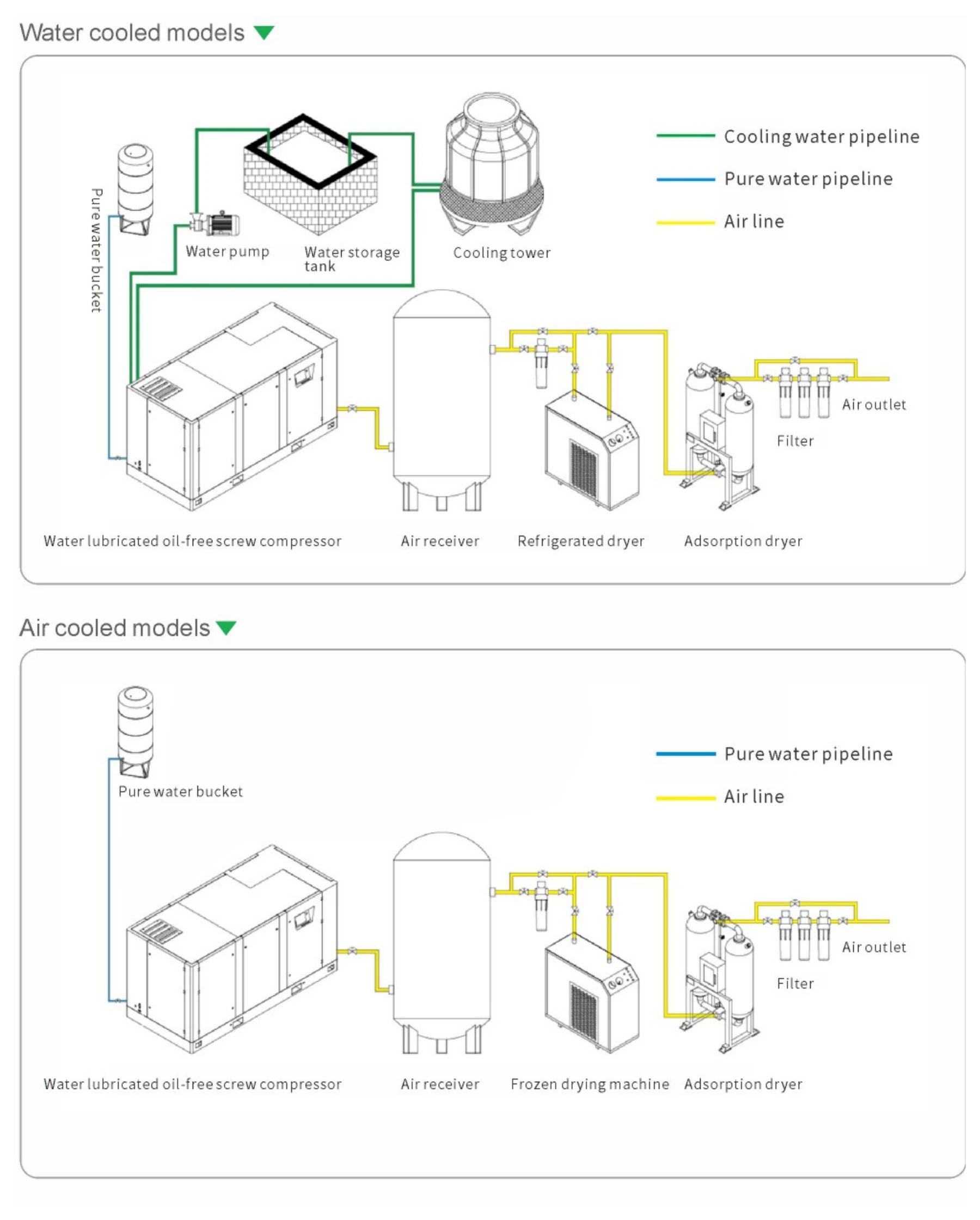
System role and safety boundary
A PSA or VPSA medical oxygen plant normally begins with atmospheric air. The compressor raises air pressure for treatment and adsorption; it does not compress the oxygen product. This distinction determines materials, cleanliness, lubrication, fire risk and regulatory scope. The compressor should be selected from the oxygen-generator inlet requirements, not from a generic “medical oxygen compressor” keyword.
Start with the oxygen demand profile and the generator's guaranteed oxygen output at its stated inlet pressure, temperature and feed-air quality. Convert this to required compressor FAD using the generator supplier's validated ratio and include realistic pressure losses. Do not infer a universal air-to-oxygen ratio from this website because adsorbent, cycle design, ambient conditions and purity target change the result.
Architecture
A typical system may include inlet filtration, compressor, aftercooling, separator, drains, air receiver, dryer and filters, PSA/VPSA generator, oxygen analyzer, product receiver, backup supply, alarms and the medical-gas pipeline. WHO's 2024 technical specifications emphasize minimum quality, safety and performance features for oxygen sources, storage and distribution products in health facilities. ISO 7396-1 covers design, installation, testing, commissioning and documentation of medical gas pipeline systems. These system-level references do not automatically certify the compressor.
Redundancy and resilience
Define whether the hospital requires N+1 compressor capacity, a separate reserve oxygen source, dual treatment trains, automatic changeover, remote alarms and fuel or power backup. A variable-frequency unit can track demand, while a fixed-speed unit can serve as base load; a mixed station may improve resilience. Sequencing logic should prevent both machines from hunting around the same set point.
Air quality and monitoring
Specify particle, water and oil classes at a defined sampling point. Include dew point, microbiological control where applicable, differential-pressure monitoring and drain-failure alarms. The catalogue's oil-free claim does not remove airborne hydrocarbons, inlet particles, water vapor or contamination introduced downstream. Commissioning should trend feed-air quality, oxygen purity, oxygen flow and system pressure through normal and fault scenarios.
RFQ data
Provide required oxygen flow and purity, generator make/model or inlet specification, site altitude and climate, compressor room conditions, required redundancy, electrical supply, receiver and treatment details, local medical-gas regulation, documentation language and commissioning scope. The proposal should return a clear responsibility matrix between compressor supplier, oxygen-generator supplier, installer and health-facility operator.
Recommended catalogue starting points
Variable-frequency standard-pressure models are logical shortlist candidates when oxygen demand changes. Fixed-speed models suit stable base-load duty or sequenced stations. The medium-pressure family is not automatically needed for PSA generation; use it only when the downstream process explicitly requires the printed 2.0–4.0 MPa air range.