Korea Ever-Power Medical Oxygen Compressor Co., Ltd.[email protected]
Catalogue-documented family

20–40 Bar Medium-Pressure Oil-Free Screw Air Compressor

Catalogue family for medium-pressure compressed air. The table includes fixed-speed and permanent-magnet variable-frequency model codes from CM75G through CM320GPV, with printed working-pressure ranges up to 4.0 MPa.

Request selection support
20–40 Bar Medium-Pressure Oil-Free Screw Air Compressor
Catalogue-derived compressor engineering visual for this product family; visible source logos and unrelated marks are excluded. Final configuration, dimensions and interfaces require an approved drawing.
10catalogue model codes
2.0–4.0 MPaprinted family range
37–160 kWprinted power entries
Page 17source evidence
Catalogue technical data

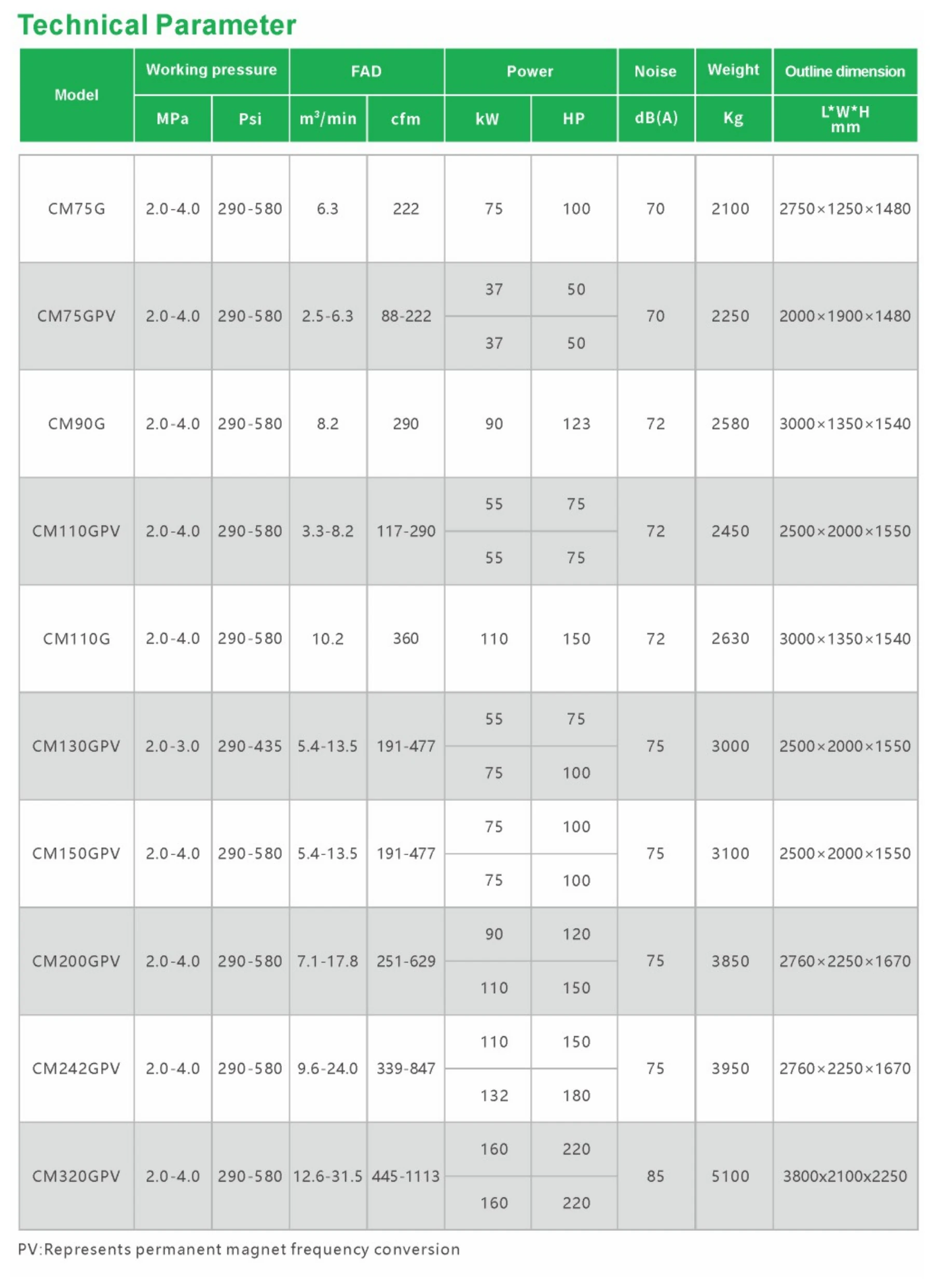
Model and performance table

Source boundary: transcribed from supplied catalogue page 17. Values are reproduced as printed. Blank or merged-cell interpretation is not silently extrapolated. The approved quotation and drawing control the order.
ModelPressure MPaPressure psiFAD m³/minFAD cfmPower kWPower HPNoise dB(A)Weight kgDimensions L×W×H mmSource note
CM75G2.0-4.0290-5806.3222751007021002750×1250×1480fixed-speed
CM75GPV2.0-4.0290-5802.5-6.388-22237 / 3750 / 507022502000×1900×1480catalogue repeats the power line
CM90G2.0-4.0290-5808.2290901237225803000×1350×1540fixed-speed
CM110GPV2.0-4.0290-5803.3-8.2117-29055 / 5575 / 757224502500×2000×1550catalogue repeats the power line
CM110G2.0-4.0290-58010.23601101507226303000×1350×1540fixed-speed
CM130GPV2.0-3.0290-4355.4-13.5191-47755 / 7575 / 1007530002500×2000×1550two power alternatives printed
CM150GPV2.0-4.0290-5805.4-13.5191-47775 / 75100 / 1007531002500×2000×1550catalogue repeats the power line
CM200GPV2.0-4.0290-5807.1-17.8251-62990 / 110120 / 1507538502760×2250×1670two power alternatives printed
CM242GPV2.0-4.0290-5809.6-24.0339-847110 / 132150 / 1807539502760×2250×1670two power alternatives printed
CM320GPV2.0-4.0290-58012.6-31.5445-1113160 / 160220 / 2208551003800×2100×2250catalogue repeats the power line
Catalogue technical table crop for 20–40 Bar Medium-Pressure Oil-Free Screw Air Compressor
High-resolution crop from catalogue page 17; use the HTML table for accessibility and the crop for visual cross-check.
Catalogue technical table crop for 20–40 Bar Medium-Pressure Oil-Free Screw Air Compressor
High-resolution crop from catalogue page 17; use the HTML table for accessibility and the crop for visual cross-check.

How to read the table: select a pressure row first, then compare FAD, motor power, cooling form, noise, weight and outline dimensions. FAD is catalogue data; verify reference inlet conditions and permitted tolerances in the quotation.

What this product family is

Catalogue family for medium-pressure compressed air. The table includes fixed-speed and permanent-magnet variable-frequency model codes from CM75G through CM320GPV, with printed working-pressure ranges up to 4.0 MPa.

The medium-pressure family is presented in the catalogue for 2.0–4.0 MPa service, with one model limited in the printed table to 2.0–3.0 MPa. Several GPV rows show two power entries or repeat a power line. Those values are reproduced exactly because the source uses merged cells and alternative entries; they must be resolved on the approved quotation and drawing. Medium-pressure air can support PET bottle blowing and other high-pressure air duties. It must not be interpreted as permission to compress oxygen-rich gas: oxygen service requires a separate, explicitly engineered compressor and oxygen-compatible risk assessment.

The intended application scope includes medium-pressure oil-free air for PET bottle blowing and other high-pressure air systems, subject to project-specific treatment, receiver and pressure-equipment review. The compressor is a source of compressed air. For a medical oxygen plant it normally sits upstream of the oxygen generator, air treatment and buffer vessels. It is not a compressor for oxygen gas and it should never be connected to oxygen-enriched gas unless a separate design explicitly approves that service.

Model range represented in the catalogue

CM75GCM75GPVCM90GCM110GPVCM110GCM130GPVCM150GPVCM200GPVCM242GPVCM320GPV
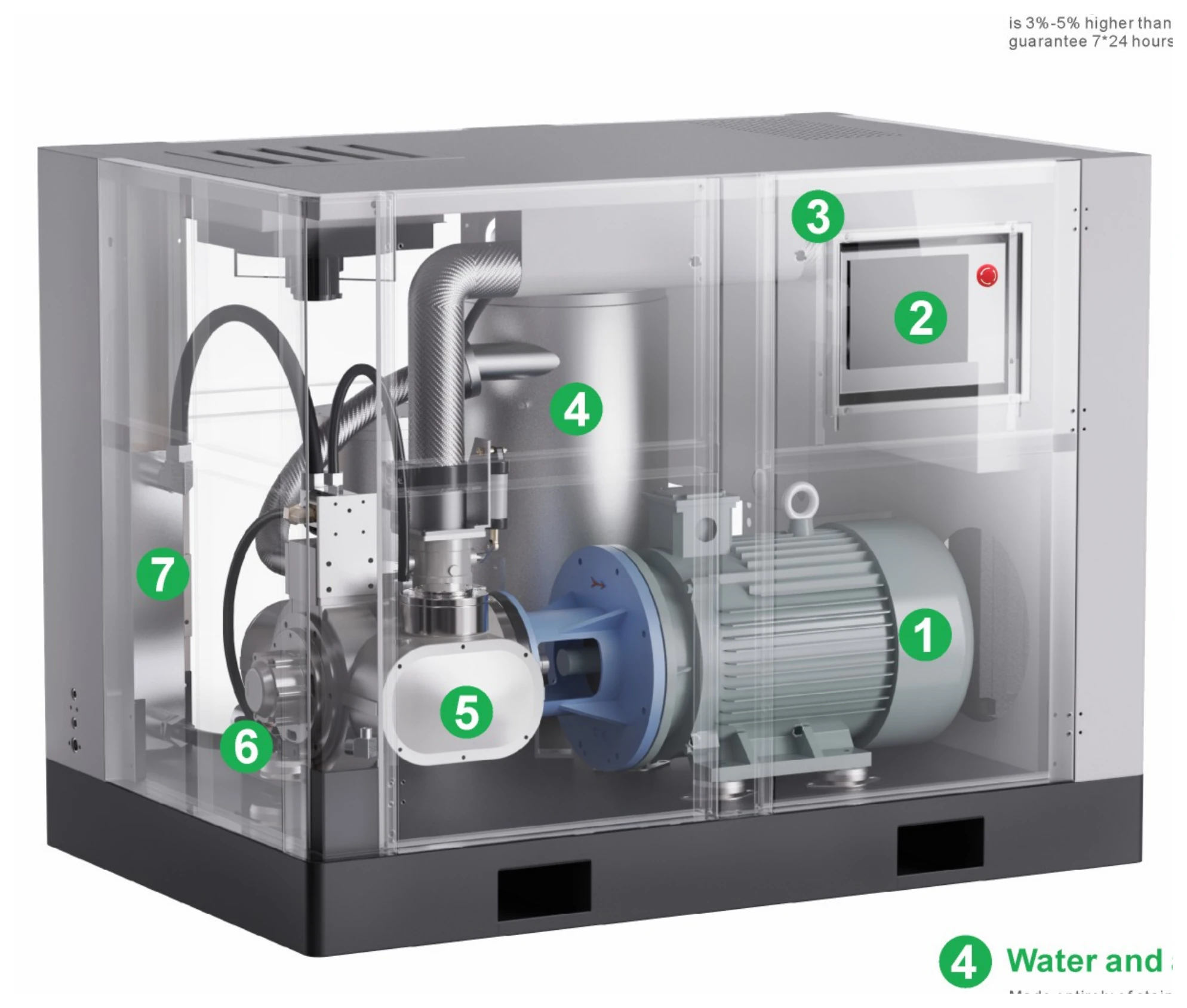
Cutaway view of an enclosed water-lubricated oil-free compressor package
Catalogue-derived component view used to explain package integration; final component selection is order-specific.
Engineering selection

Turn an air requirement into a defensible compressor selection

1. Define the duty point

State normal, minimum and peak FAD; required pressure at the process inlet; operating hours; start-stop limitations; and whether a single unit, duty/standby pair or sequenced station is required. Use actual plant measurements when replacing an existing machine. Do not add an arbitrary safety factor without documenting why it is needed.

2. Build the pressure budget

The model table gives compressor working pressure. The process receives less after pressure losses through the aftercooler, separator, dryers, filters, check valves, receiver, distribution header and oxygen-generation skid. Calculate the worst credible pressure loss at peak flow and dirty-filter condition.

3. Define air quality

Write the required ISO 8573-1 class notation for particles, water and oil at the stated measurement point. The catalogue presents an oil-free/Class 0 marketing claim, but a purchase specification should request the exact class triplet, test method, sampling point and evidence for the offered configuration.

Integration into a PSA or VPSA medical oxygen system

In a pressure-swing adsorption system, clean compressed air is the feedstock from which nitrogen is preferentially adsorbed. Compressor selection therefore affects oxygen-plant throughput, cycle stability, adsorbent protection and total energy use. The site must coordinate compressor FAD and pressure with the oxygen generator's validated inlet window rather than choosing both packages independently. A feed-air receiver can reduce short-cycle demand, while correctly sized filtration and drainage protect the downstream process from condensate and particulates.

The health-facility oxygen system is wider than the compressor. It may include inlet filtration, air treatment, oxygen generator, analyzer, product receiver, booster or filling system where permitted, alarms, reserve supply, pipeline distribution and documented commissioning. The compressor page therefore does not claim that the machine alone creates medical oxygen or that it is a certified medical device. Local regulations, pharmacopoeial requirements, risk management and the oxygen-system supplier's validation control the final project.

For medical-air service, the required quality and monitoring regime can be different from feed air for an oxygen generator. The buyer should identify whether the air will contact patients, drive instruments, feed a PSA plant, or serve a general industrial utility. Never merge these duties under a generic “medical compressor” label without a piping and hazard review.

Safety boundary: this catalogue describes air compressors. Oxygen-enriched gas is highly oxidizing. Do not use these machines to compress oxygen unless the quotation, materials, cleaning process, lubrication concept and risk assessment explicitly state oxygen service.
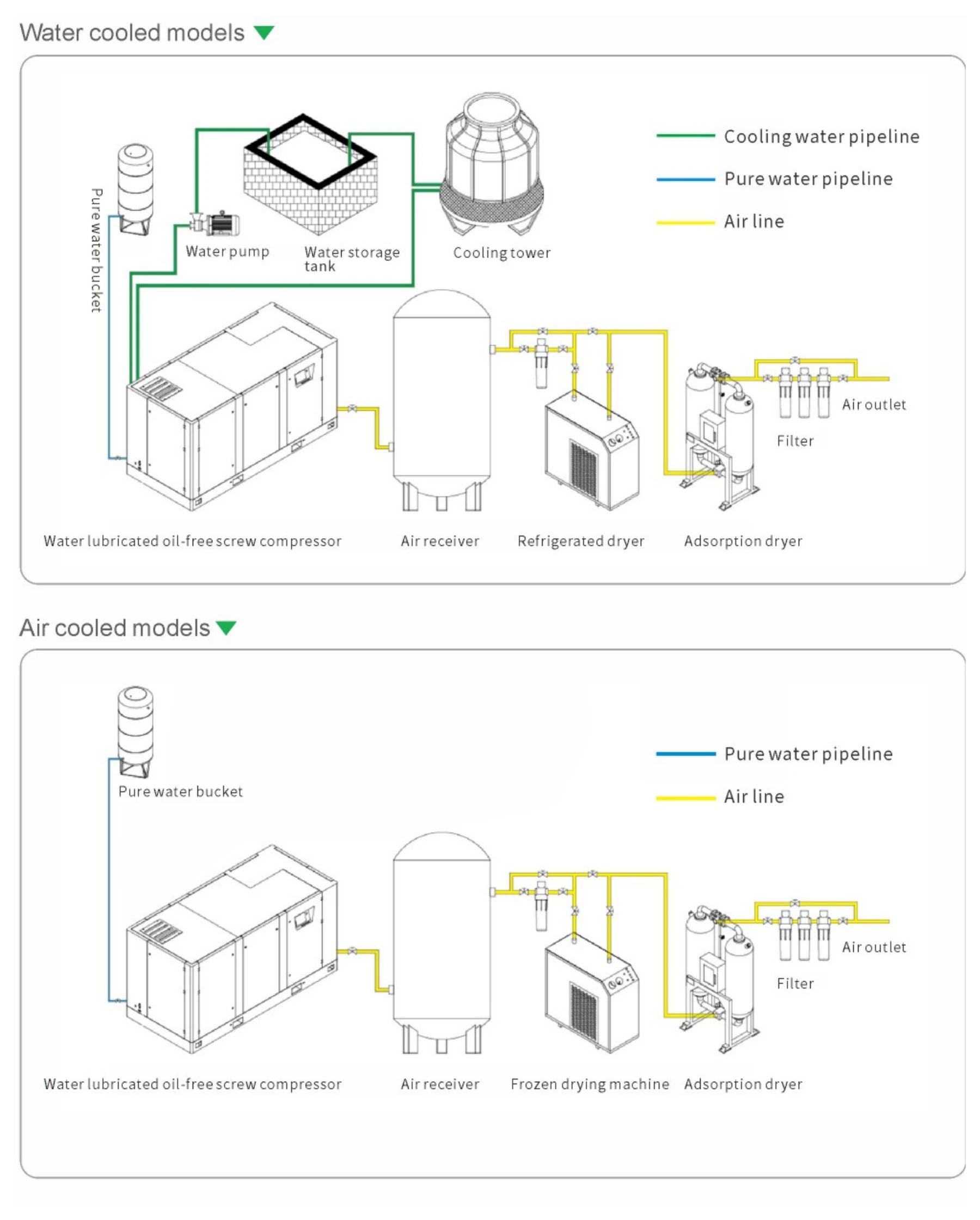
Water-cooled and air-cooled compressor flow diagrams
Catalogue flow diagrams retained as engineering context. Verify the offered cooling arrangement on the approved P&ID.

Cooling, water and site utilities

The catalogue distinguishes air-cooled values with an “F” suffix and orange data in the standard-pressure tables, while models without “F” are described as water-cooled. This distinction changes package dimensions and weight, and it changes the buyer's utility checklist. For air cooling, confirm maximum ambient temperature, altitude, ventilation path, recirculation risk, inlet cleanliness and the heat rejected to the compressor room. For water cooling, specify inlet temperature, allowable temperature rise, water quality, pressure, flow, fouling allowance, corrosion control and whether the circuit is once-through, tower water or closed loop.

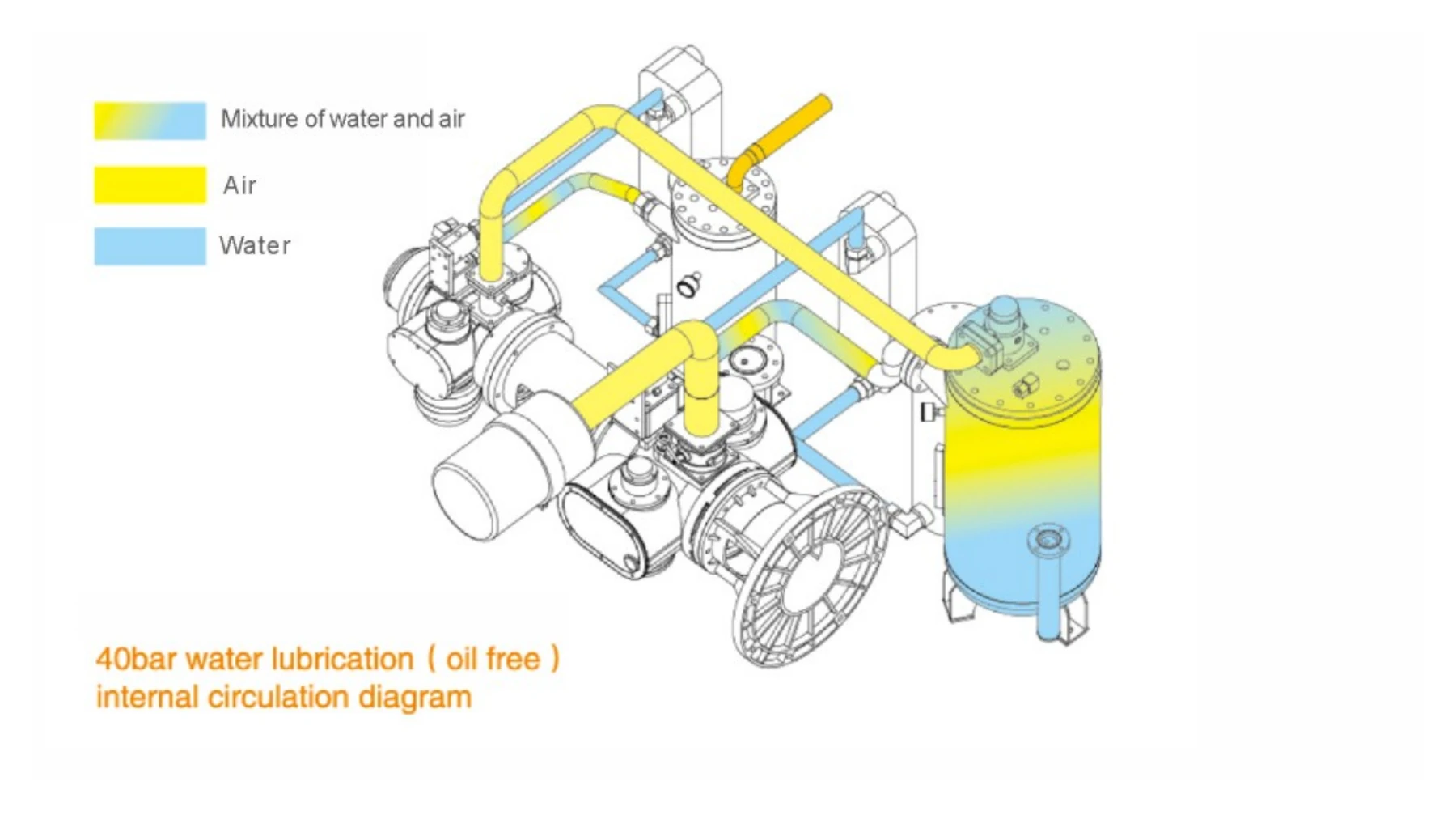
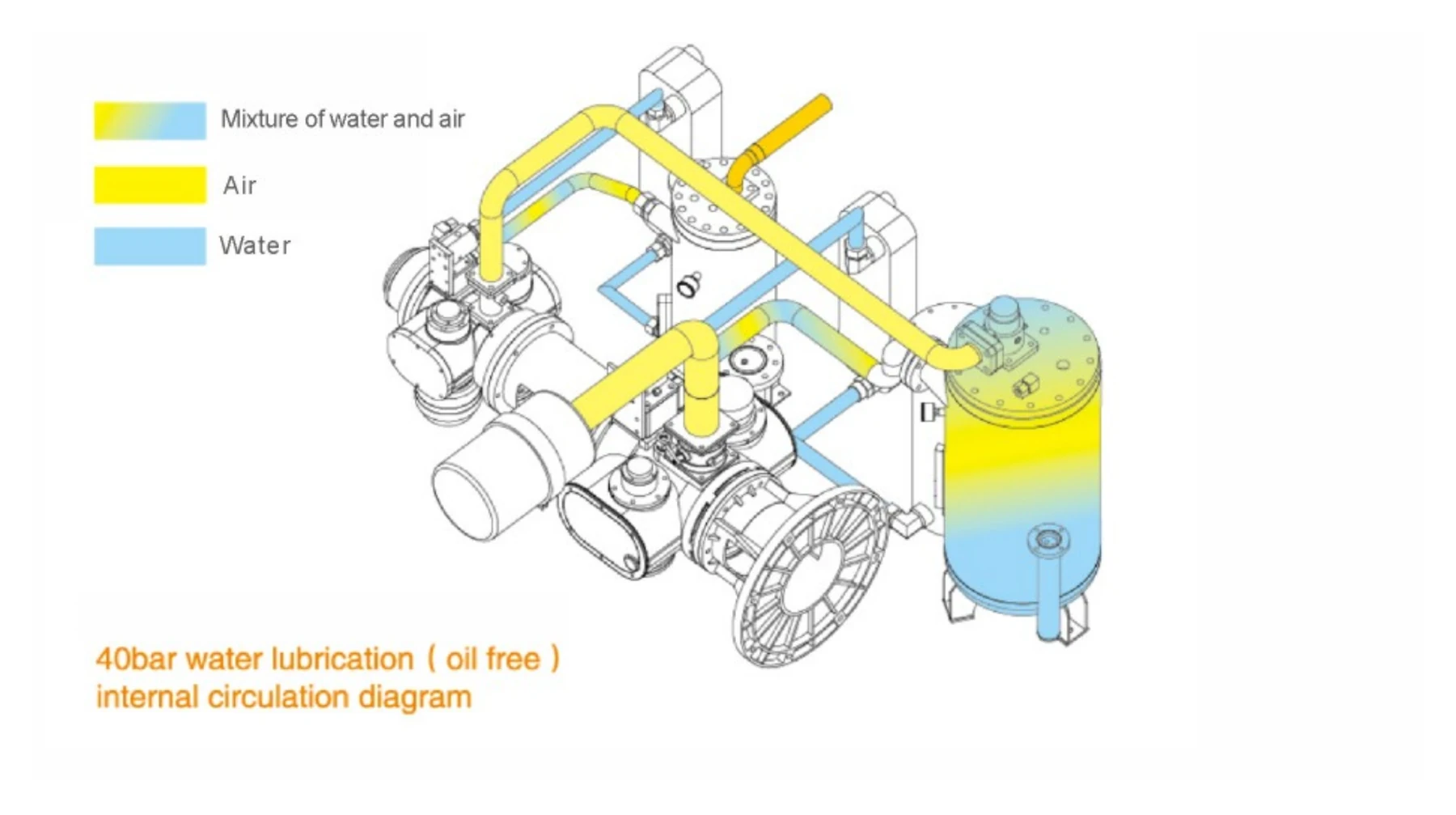
Water-lubricated compression also requires attention to water quality and separator performance. The supplied catalogue illustrates a lubricating-water filtration system, water cooler and water/air separation barrel. The order specification should identify consumables, drainage, water make-up, winterization and the consequences of a utility-water interruption. These details are not fully defined in the catalogue and remain engineering-review items.

Electrical data must include site voltage, phase, frequency, permitted voltage variation, earthing, short-circuit level, motor starting constraints, VFD harmonic requirements where relevant, and the control interface. Catalogue kW and HP values are model-table fields, not a complete electrical schedule.
Installation and commissioning workflow

  1. Approve the model, pressure row, cooling form and outline dimensions against the latest commercial quotation and general arrangement drawing.
  2. Check foundation loading, lifting points, access clearances, door removal space, ventilation and maintenance routes. Catalogue weight is useful for planning but the final shipping and operating weight should be confirmed.
  3. Clean and pressure-test downstream piping independently. Install flexible connectors only where permitted and support piping so nozzle loads are not transferred to the package.
  4. Install the air receiver, drains, relief devices, isolation valves and non-return valves in the correct order. Never isolate a pressure vessel from its relief device.
  5. Confirm rotation, oil-free water circuit readiness, cooling-water flow or ventilation, electrical protection, emergency stop, alarm contacts and remote permissives.
  6. Commission against a documented test sheet: inlet conditions, discharge pressure, FAD or process throughput, temperatures, vibration, noise, dew point, differential pressures, drain operation and oxygen-generator response.
  7. Record baseline readings for later maintenance. Training should cover normal shutdown, emergency response, lockout/tagout, water-system care, filter replacement and alarm escalation.

Commissioning should not be reduced to “machine starts and makes pressure.” A medical oxygen project needs a traceable handover showing that the compressor, treatment train and oxygen system operate together through normal, peak, standby and fault scenarios.

Maintenance and troubleshooting

Use the supplied operation manual and serial-number-specific parts list. A useful maintenance plan separates daily condition checks from calendar tasks, running-hour tasks and condition-based interventions. Daily checks can include pressure, temperature, drain function, abnormal sound, water level or quality indicators, cooling performance and alarm history. Planned work may include intake and process filtration, cooling surfaces, water filtration, separator inspection, electrical connections, safety devices and calibration of critical instruments.

Low pressure at the process can result from excessive demand, a dirty intake, downstream pressure loss, a control set point, a leaking valve or a compressor problem. High temperature can result from ventilation recirculation, inadequate cooling water, fouled heat exchange surfaces, incorrect water flow or high ambient conditions. Frequent starts often indicate insufficient receiver volume, an unsuitable control band, leakage or a machine that is oversized for the minimum demand. Diagnose the system before replacing major parts.

For oxygen-generation duty, trend oxygen purity and production together with compressor pressure and FAD. A falling oxygen result may come from air supply, air treatment, valve timing, adsorbent condition, analyzer issues or downstream leakage. The compressor should not be blamed—or cleared—without correlated data.

RFQ and drawing-approval checklist

  • Application and whether air feeds PSA/VPSA, medical air, PET blowing or another process
  • Required FAD at normal, minimum and peak demand
  • Required process pressure and estimated downstream pressure loss
  • Site altitude, ambient temperature and humidity
  • Air-cooled or water-cooled preference and utility details
  • Power supply, voltage, phase, frequency and controls interface
  • ISO 8573-1 particle/water/oil class target and sampling point
  • Required redundancy, receiver volume and operating hours
  • Local pressure-equipment, electrical and machinery compliance requirements
  • Indoor/outdoor installation and enclosure/IP expectations
  • Noise limit and measurement condition
  • Languages, documents, certificates and inspection plan required with the order

Final manufacture and shipment must follow the approved quotation, model schedule, wiring diagram, P&ID and general arrangement drawing. The website table is a selection aid and evidence transcription; it does not replace the signed project documents.

Frequently asked questions

Is this an oxygen compressor?

No. The catalogue supports oil-free compressed-air packages. In a medical oxygen plant the machine normally supplies air to the PSA/VPSA generator. Oxygen-gas compression requires a separate oxygen-service design.

Can the website table be used as the purchase specification?

Use it for shortlist and RFQ preparation. The approved quotation and drawing must resolve cooling form, voltage, options, exact interfaces, ambiguous merged cells and project compliance.

What does the F suffix mean?

The catalogue footnote states that CM-F indicates an air-cooled model and orange data are air-cooled parameters. Models without F are water-cooled.

Does oil-free automatically mean medical grade?

No. Oil-free compression addresses one contamination route. Medical oxygen or medical air quality depends on the complete system, treatment, monitoring, commissioning and applicable regulation.

How should variable and fixed speed be compared?

Compare the measured demand profile, minimum demand, pressure stability, control method, sequencing plan, lifecycle energy and maintenance—not only motor power or maximum FAD.

Send the duty point, air-quality target and site conditions

We will map the requirement to catalogue-supported configurations and identify the information that still needs an approved engineering drawing.

Email [email protected]